Commercial Floor Sanding London | Get a Free Quote

Before and after commercial hardwood floor sanding and restoration in a London pub and bar space.
Commercial Timber Floors Need More Than Domestic Sanding
A floor in a family sitting room and a floor carrying several hundred people every day are two different jobs. Commercial sites bring trolley wheels, grit, chair movement, entrance moisture, cleaning chemicals, food contamination and concentrated wear patterns that domestic-grade finishes are rarely designed to tolerate.
Building stock around London and the Home Counties adds another layer. We regularly encounter Victorian pine boarding in converted properties, oak blocks in Edwardian schools and institutional buildings, parquet in church and assembly halls, and later engineered floors installed over screed in offices, retail units and hospitality premises.
Old floors also tend to contain previous repairs. Bituminous adhesive, loose blocks, plywood patches, softwood infills and several incompatible coatings may all be present within the same room. Sanding everything indiscriminately until it looks pale is not restoration; it is a quick way of removing valuable wear layer and leaving the underlying faults untouched.
- Open joints: trap soil and cleaning residue and can allow moisture to reach block edges.
- Loose parquet: movement under foot can break surrounding tongues, blocks and brittle historic adhesive beds.
- Worn entrance zones: exposed timber absorbs water and grit considerably faster than a properly sealed surface.
- Uneven coatings: localised polishing or repeated proprietary dressing can leave slippery or poorly bonded patches.
- Moisture: elevated screed or timber readings can cause cupping, adhesive failure and premature coating problems.
- Deep contamination: oils, silicone cleaners and some maintenance chemicals can interfere with lacquer adhesion.
- Slip performance: finish selection needs to suit the actual environment rather than simply delivering the highest possible sheen.
Our Step-by-Step Commercial Floor Restoration Process
Step 1: Subfloor Audit & Moisture Testing
We start by finding out why the floor has deteriorated, not simply how quickly it can be sanded. Timber type, construction, previous finish, fixing method, subfloor condition, perimeter movement and service penetrations are recorded during the site inspection.
Where a floor is bonded over screed, moisture readings are taken with appropriate meters and, when conditions warrant it, checked using an in-situ or hood-type hygrometer assessment. Sanding and sealing a floor while moisture is still migrating through the substrate simply hides the problem until movement, whitening or adhesive failure appears later.
On schools, public buildings, managed commercial premises and contractor-controlled sites, the job can be supported with site-specific RAMS and COSHH documentation. Access, electrical loading, dust containment, waste handling, fire routes, public segregation and reopening times are agreed before work starts.
Step 2: Timber Repairs, Re-Bonding & Resin Gap-Filling
Loose parquet is dealt with before main sanding. Where the substrate and block condition permit, failed blocks can be lifted, cleaned and re-bonded using a suitable flexible silane or silylated-polymer parquet adhesive rather than a rigid general-purpose grab adhesive.
Replacement blocks are selected to suit the existing species, thickness, dimensions and grain as closely as practical. A quartersawn oak block beside mismatched pale beech is noticeable after finishing, so timber identification matters before repairs are ordered.
Fine stable joints can be filled using clean sanding dust mixed with a compatible resin binder to form a resin-slurry filler. Large seasonal gaps, structural movement joints and unstable boards are treated differently; filling every gap rigidly can create more trouble when the timber expands again.
Step 3: HEPA Dust-Controlled Sanding & Surface Preparation
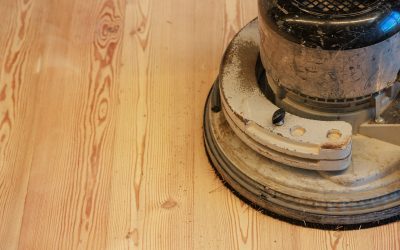
For the main cut we use professional belt-sanding equipment such as the Lägler HUMMEL, selected according to the floor construction and the amount of material that actually needs removing. Abrasive sequences are adjusted to the coating, timber density and condition rather than following one fixed grit schedule on every job.
Edges, corners, thresholds and radiator or fixture zones are mechanically prepared to the same standard as the field of the floor. Poor commercial sanding nearly always gives itself away around skirtings and doorways, where coarse scratches or old lacquer have been left because the operator concentrated on the easy open area.
Dust extraction is connected to suitable industrial extraction equipment with high-efficiency filtration, including HEPA H14 filtration where required by the site specification and risk assessment. No sanding process is literally dust-free, but correctly connected professional extraction makes a substantial difference to airborne dust, adjoining rooms and final coating quality.
Final abrasion removes the previous sanding pattern and produces a consistent surface suitable for the chosen coating system. The floor is then thoroughly vacuumed, edges checked under directional light and contamination risks dealt with before any lacquer, oil or primer is applied.

Step 4: High-Traffic Lacquers, Hardwax Oils & Anti-Slip Systems
A busy commercial floor needs a coating selected for service conditions rather than colour alone. For heavily used halls, schools, shops and hospitality spaces, we commonly specify professional 2K waterborne polyurethane lacquers where their hardness, chemical resistance and maintenance characteristics suit the floor.
Two-component systems use a measured cross-linking catalyst or hardener. Once mixed, the coating has a defined working pot life, so correct ratios, temperature, film thickness and overcoat windows matter; adding extra hardener does not make the finish stronger.
Hardwax oil may be preferable where repairability, a lower-build appearance or the character of older oak and pine is important. It is not automatically the correct answer for every restaurant, bar or high-spill environment, so cleaning regime and expected contamination need to be considered before specification.
Where slip risk is a specific operational concern, we discuss the required finish system and testing regime with the client. BS 7976-2 pendulum testing can form part of a documented slip-resistance assessment, particularly where the building operator needs measurable evidence rather than a manufacturer’s marketing description such as “non-slip”.
Low-emission primers, adhesives and ancillary products can also be selected where occupied schools, healthcare environments, offices or public buildings require tight VOC controls. EC1 Plus-rated products are available within the professional flooring market for applications where very-low-emission materials form part of the project specification.
Step 5: Aftercare & Commercial Maintenance Protocols
The first maintenance decision is made before we leave site. We provide guidance on initial cure, furniture replacement, entrance matting, chair protection, cleaning chemistry and when mechanical maintenance should begin.
Strong alkaline cleaners, steam equipment and indiscriminate polish applications cause a surprising amount of avoidable damage. A properly finished wood floor normally responds better to controlled moisture, correctly diluted neutral cleaner and periodic professional inspection than repeated attempts to make it “shiny” with unsuitable supermarket products.
Planned maintenance is particularly useful in reception areas, corridors and dining spaces because these zones can often be cleaned, lightly abraded and recoated before wear reaches bare timber. That keeps more of the original floor intact and reduces the frequency of full commercial sanding cycles.
Night, Weekend and Phased Commercial Floor Sanding
For most commercial clients, programme planning is as important as sanding quality. A technically excellent coating is no use if the restaurant cannot open, the school corridor is inaccessible on Monday morning or staff have to walk through uncured lacquer.
We therefore programme around access windows, coating cure times, ventilation, security and the sequence in which areas need to return to service. Light foot traffic and full operational use are not the same thing; furniture loading, cleaning and heavy pedestrian use may require longer than the minimum touch-dry period.
| Working Arrangement | Operational Benefit | Typical Facility Suitability |
|---|---|---|
| Overnight Working | Allows sanding and controlled coating operations outside customer or staff hours, with reopening planned around the specified cure window. | Retail units, restaurants, reception areas, offices and selected hospitality premises. |
| Weekend Phased Works | Provides a longer uninterrupted period for repairs, sanding, multiple coats and initial cure before weekday occupation resumes. | Schools, offices, churches, community buildings and commercial halls. |
| Sectional Restoration | Keeps part of a large building operational while clearly segregated areas are restored in sequence. | Large schools, corridors, public venues, care facilities and multi-room commercial buildings. |

Before and after commercial parquet floor repair, sanding and restoration in a London office space.
Commercial Floor Sanding for Schools, Churches, Restaurants, Shops and Halls
Schools and Educational Buildings
School floors frequently combine heavy grit loading, chair abrasion and concentrated corridor traffic. Holiday working is often preferable because repair, coating and cure periods can be managed properly without routing children or staff around freshly finished sections.
Churches and Community Halls
Older church and hall floors often contain pitch pine, oak parquet or mixed repairs from several decades of use. Pews, stages, heating systems and fixed furniture require careful sequencing, particularly where the objective is to retain the aged character rather than produce an unnaturally new-looking surface.
Restaurants, Pubs and Hospitality Floors
Hospitality floors see chair movement, grit, grease, drink spills and frequent damp cleaning. Finish specification must therefore consider chemical resistance, repairability and available closure time rather than simply choosing between matt and satin.
Retail and Commercial Units
Shop floors often fail first between the entrance, tills and principal customer routes. Sectional working and out-of-hours restoration can reduce business interruption while allowing high-wear zones to receive the same preparation standard as less visible parts of the floor.
Commercial Compliance, RAMS and Site Control
Commercial restoration begins with site control. Where required, works are supported by RAMS, COSHH information, equipment checks and agreed segregation measures, with operatives briefed on the specific risks presented by the building.
Emergency routes, public interfaces, power supplies, extraction hoses and material storage are considered before machines are brought into the working area. On occupied premises, we also agree noise-sensitive periods, loading arrangements and exactly who has authority to release completed areas back into service.
Where a measurable slip-resistance requirement forms part of the project, the floor system and testing protocol should be specified before coating rather than discussed after handover. Pendulum testing to BS 7976-2 can be incorporated where appropriate to the client’s safety management requirements.
See the Standard of Work Before You Commission It
Commercial flooring proposals are easier to assess when you can see comparable work rather than relying on generic manufacturer photographs. Our commercial floor sanding gallery shows the sort of worn timber, parquet repairs, sanding stages and finished surfaces that make up real restoration projects.
Budget is normally affected by area, floor condition, repairs, existing coatings, access, working hours and the specified finish system. For guidance before arranging a survey, visit our floor sanding prices page; final commercial quotations are based on the actual site rather than an unrealistic one-rate-fits-all square-metre figure.
Commercial Experience You Can Check Before Work Starts
Commercial projects can be undertaken by appropriately trained, CSCS-carded site operatives where the project or principal contractor requires it. Suitable commercial liability insurance documentation and project-specific safety information can be supplied during the pre-start process.
The quotation process is straightforward. Site photos, short videos, approximate measurements and floor plans help us establish the likely scope initially, but where repairs, moisture, unknown coatings or substantial commercial areas are involved, a physical site survey is the sensible basis for a firm specification.
You will know what is being allowed for: repairs, sanding, gap treatment, number and type of finish coats, working pattern and any important exclusions. It is much easier to compare commercial quotations when each contractor has actually stated what they intend to do to the floor.
When Does a Commercial Timber Floor Need Full Sanding?
Not every tired floor needs stripping back to clean timber. If the existing coating remains bonded and sufficient protective film is present, deep cleaning, mechanical abrasion and a compatible maintenance coat may be the more responsible option.
Full sanding becomes more appropriate where the finish has worn through extensively, staining has entered the timber, deep scratches cannot be corrected by surface preparation, or previous coatings are failing. We would rather preserve usable timber than remove it simply because a sanding machine is available.